on the wrong side of sunrise

Author: Alice Thomsen (Page 5 of 11)

What Big Teeth You Have

I’ve mentioned before the fiction workshop I’m taking this semester, specializing in linked stories. (If you want to follow along with the course, check out our class blog.) The basic idea of linked stories is that they’re too connected to be wholly separate stories and still have the same impact (that is, they function as stories alone but become more powerful in combination) but too distinct to be a novel(/novella). If this sounds like a slippery definition, that’s because it is. There’s a whole messy space between collections of unrelated stories and novels that’s inhabited by linked stories, story cycles, novels in stories, composite novels, etc.

I took something of a hiatus from writing anything complete from 2003–2005 (during which time I considered, among other things, becoming a high school band director) and picked it back up on a whim when a friend of mine instructed me to do NaNoWriMo. (I do mean instructed. There was no, “Hey, I’m going to do this thing. Want to do it with me?” There was only, “Do NaNoWriMo.”) It was a messy month—I came up with my concept at the last minute, realized when my planned plot concluded that I only had half of the 50,000 words, and only finished because Thanksgiving Break afforded me the opportunity to lock myself in the bathroom, away from distractions, and pound out 7,000 a day. But I finished a project that I lovingly called the SVN, because titles have never been my strong suit.

The SVN involved five different viewpoint characters, and although that messy first draft didn’t make the best use of them, by the time I’d been through several revisions (for three years, although I had other side projects, it was my focus) each of those characters had an arc, all of which converged in the penultimate scene.

In other words, the SVN could, in a way, be considered a collection of linked stories, interwoven with one another.

I wrote another NaNoWriMo novel in 2008 (my next serious project) that had two viewpoint characters who spent the majority of the plot not knowing of each other, much less their connection. Again, their arcs joined up as the story neared its end; again, I could rephrase that as, their stories joined up as the piece neared its end.

My current project is a single viewpoint chronological narrative—free of murkiness—but it occurred to me that it’s the exception. Of the novels/sort-of-novels I’ve written, almost three-quarters have been, to some extent, separate but linked stories.

That said, they’ve all be much closer to the novel end of the spectrum. There are separate character arcs, but they’re all structured around the central conflict, whatever that is, and even when the characters don’t yet know each other, it’s clear to the reader that they’re all directly tied to that conflict, so they’re only ever as distant as a friend of a friend(/enemy of an enemy, etc.). I consider those pieces to be novels … but I suppose it’s rarely quite so simple.

I’ve adamantly defended my novelist identity; the idea that I might be dipping so much as a toe into that murky in-between water seemed, until about 3:15 this afternoon, impossible. It’s disconcerting. Because Continue reading
On College Writing (by way of preschoolers)

This is cross-posted (with slight variation) on my brand new temporary side blog, I have an office. I’m keeping it as a place to process my learning-to-be-a-teacher thoughts, and I might draw from it now and then if I have a thought that comes together well.

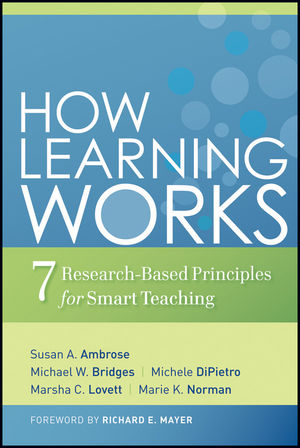
A few days ago, I started How Learning Works, and it brings up a lot of principles from my undergrad psychology studies. The third chapter in particular makes me think of a psychology class I had my last semester of undergrad, which was actually called Learning. It was behavioral psychology learning, not education learning, but a huge chunk of behavioral psychology is operant conditioning—all about shaping behavior with consequences. And this is where motivation comes in.

Take the different forms of value, for instance. Intrinsic value, my psych professor asserted, rarely comes out of nowhere—there’s almost always something that precedes it. Example: most pianists who play because of the intrinsic value they find in it didn’t just decide, out of the blue, that this pursuit was valuable. The closest jump would be that boredom/curiosity/etc. gave value to exploring the environment, and the piano that happened to be there had instrumental value (get it?) as a way to alleviate boredom/satiate curiosity. Only then can the piano take on its own value. But that often isn’t the case. A lot of pianists had piano lessons as a kid, something selected—and incentivized—by the parent.

Nothing is intrinsically intrinsically valuable, short of basic life needs. Intrinsic value develops with time—sometimes quickly, sometimes not.

Here, though, is the twist: we have to be careful how we reward things. There are risks involved. Lepper, Green, and Nisbett did a study in 1973 with preschool kids—not exactly a college writing class, I know, but bear with me.

So one day, you sit down three groups of kids with markers and tell them to draw. You tell the first group they’ll get a reward at the end for drawing; you surprise the second group with a reward; and the third group gets no reward. Three days later, you reconvene the groups and set them in a playroom with, among other things, markers and paper. Do you see a change in the rate of drawing?

Yes. But it’s complicated.

What typically gets reported when the study is cited is that the group that got no reward had higher rates of drawing than the group that was told they’d get a reward. This means, people will say, that extrinsic reward actually undermines motivation. (It’s the whole, I love writing, so if I got paid to do it, it would be ruined! sort of thinking.)

Except you had three groups, remember? And the group of kids that got a surprise reward drew just as much as the group that got no reward. So this means that extrinsic reward has no effect, then? No, not that either.

With a little probing into these kids’ histories, you can break them down into “low-base-rate” and “high-base-rate” drawers—i.e., kids who, left to their own devices, didn’t draw much, and kids who did. The group with no reward saw no change to either group. The group with the surprise reward saw a higher rate in the low-base-rate kids, as did the group with the expected reward. But that group saw a drop in high-base-rate kids.

Why might that possibly be?

Here’s an analogy. I could say, “Want to help me with Project A?” Or I could say, “Want to help me with Project B? I’ll give you five bucks.” While the five dollars is a nice offer, it also might—reasonably—lead you to suspect that there’s something unpleasant about Project B. You go in with the assumption that this is a trade—that you’re taking a loss (your effort) in exchange for a gain (five dollars), as am I (reversed). By offering you the money ahead of time, I’ve framed it as a chore, and since I’m having to add extrinsic value to the equation, Project B must not have intrinsic value.

And that’s the tricky thing with incentives. (Well, one of them.) A lot of people don’t come into a writing class finding writing intrinsically valuable. But lumping on simple extrinsic value isn’t necessarily the best way to resolve that.

I met with my mentor Friday, along with her other mentee. He asked about creating student interest in the class, and it’s a good question—particularly with a class like this. It’s not just that they need a 300-level lit class and they picked the one that looked best; it’s that they need this specific composition class—there’s no element of choice involved, except “Now or later?”

The first thing, our mentor said, is to get them arguing with one another.

Which, when she said it, made perfect sense. These students might not find intrinsic value in writing, but who doesn’t find intrinsic value in being right—in being recognized as being right? Start off there, and writing becomes instrumentally valuable, but not in a way tied to an unrelated reward—in a way that’s organically connected to a reward. Writing isn’t a chore you complete to get a grade; it’s a tool for demonstrating how deliciously right you are.

Pulpy Marshmallows (or, how I became an embittered novelist)

I’ve said it before; I’ll say it again. Cathy Day is the reason I applied to the graduate program I started today, and although she isn’t the sole reason I picked it over the others that accepted me, she is a big one. This semester, I’m taking a fiction workshop with her, and in preparation, I read this.

I was going to quote some passages, but then I realized I wanted to quote the whole thing, so instead, just go read it. Seriously. I’ll wait.

Back? Okay. Still here, because you didn’t actually go read it? I’m not kidding. GO.

Now that you’ve read it, let’s talk. My writer friends will back me up on this: I hate short stories with a passion that borders on pathological. (Okay, they might not say borders.) If pushed, I will grudgingly admit that now and then, I do come across a short story I enjoy, and I have written a few that I found tolerable, but those are the exceptions. I hate short stories.

So when Day writes, as you recall, “I know without a doubt that when I was growing up, I absolutely loved to read novels and rarely read short stories unless they were assigned in a class,” I’m with her. It’s #9, though, Writing Right-handed vs. Left-handed, that really got me.

Sometimes a left-handed novelist is wise or stubborn enough to realize that he is not a right-handed story writer with horrible penmanship, but more accurately a beautiful left-handed novelist with perfectly fine penmanship. When he is alone, away from school, he brandishes the pencil in his left hand and sighs. Ahhhhhh. Then in college, he takes a workshop, which is full of nothing but right-handed desks. He puts the pencil in his right hand. Out of necessity, he’s become ambidextrous. And so, he goes through the motions of writing right-handed short stories for class. Assignments that must be completed. Hoops to jump through so that he can be in this class, read books for credit, and get a degree in the writing of fiction. At night, he goes home and puts the pencil in his left hand and works some more on his novel, the pages of which he never submits to his teacher, whose syllabus clearly states that they are to submit short stories that are 8-15 pages long.

If I had a dollar for every time I’ve called short stories a hoop to jump through, I could buy so many more cereal marshmallows than one person needs. And then I could eat homemade Lucky Charms, gnashing my teeth and enjoying the bitter fantasy that the marshmallows were made of the pulped pages of short stories (which, let’s be honest, is plausible).

That’s the key: bitter fantasies.

When I was eleven, I wrote my first novel-of-sorts. It was a hundred-something pages, and I entered it in our local 4-H fair. The rule book didn’t have a page limit for creative writing submissions. I checked.

Come show day, I plopped my binder on the table in front of the judge. She looked the size of it, read the first paragraph, and gave me an honors ribbon that I knew had nothing to do with the quality of my work.

The next year, the rule book specified a ten-page limit. I brought in the first chapter of my new novel-in-progress. Suffice it to say that the year after that, they also instituted formatting requirements.

It’s always been that way. When I want to have the work I care about read, the Powers That Be won’t read it, so instead I put forth work that, to be honest, I don’t really care about. I get grades (which are what count) and feedback (which I file away, in case at some point I need, say, application material) and go back to what I do care about.

There are things fiction writers can learn from poetry. It’s the same line I hear when I say I want to be a novelist, and it’s true—there are things a novelist can learn from short stories. Still, my poetry-focused undergraduate program left me feeling adrift, alone, and embittered, and my short-story-focused education has left me the same way.

I’ve been lucky to have friends and family who have been supportive and interested in my real work. But am I really just spending thousands of dollars and years of my life in the hopes of jumping through enough hoops that one day I can get a couple letters after my name to identify me as a Real Writer, then go be a novelist in peace?

I think not. I hope not. My graduate program is not well-suited to novel writing, and I knew it wouldn’t be, just as I know my professors don’t have the resources to work with me on a novel. Wednesday, though, I start that fiction workshop. We’re focusing on linked stories. It’s not novels, no, but you read the article—I don’t have to tell you that it’s a sign that somewhere out there, there exists something bigger than the standalone 8–15 pages.

The Five-Paragraph Essay (feat. a sports analogy)

Incidentally, today is the thirteenth of August. On the fourteenth, I have the first of several orientation sessions, and on the nineteenth, I attend the first class of my graduate studies.

Incidentally, it isn’t a graduate-level class. It’s ENG 103: freshman composition. I’ll be going to every session, though, because come January, if all goes as planned, I’ll be teaching a section of it myself.

Incidentally, this prospect is terrifying.

It’s also exciting, though, and it has me reflecting on my experiences, good and bad, in English classes—considering what I might borrow and what I want to avoid. I never took a standard freshman composition course, but between high school and college, I had enough classes to give me a wealth of material for contemplation. Of particular interest is …

The Five-Paragraph Essay

The five-paragraph essay is just a Mad Libs where you know the topic ahead of time, and so formulaic that it makes drugstore romance novels look innovative. I say, “Give me a topic sentence. Okay, now give me a supporting point, and another, and another. Now a transition,” and you say, “Cats make great pets. If you’re stuck on a paper and don’t know what to write next, they’ll walk all over the keyboard to help you out. If you’re having trouble sleeping at night, they’ll sing you a yowling lullaby. If you’re spending too much time on the computer, they’ll come over and nip at your fingers until you stop and pay attention to them. Cats aren’t just useful as pets, though.” Like communication techniques well-meaning counselors teach badly—e.g., active listening and “I” statements—the five-paragraph essay leaves everyone feeling unfulfilled. To my knowledge, nobody likes to read a five-paragraph essay, and nobody likes to write one.

So we should just ditch the form, right? Well, no.

The way I’ve come to look at it—and the way I wish it had been presented to me—is that the five-paragraph essay is an exercise, a training drill. Will you use it anywhere in the real world? Not unless you’re teaching it (and classifying academia as the “real world” is debatable). Similarly, for a football player, there is (I am told) value in running back and forth across the field, undulating thick ropes, running through tires, and … whatever C.J. Spiller doing over there. It’s not fun to do, and it’s not exciting to watch, but it builds strength and fitness and gets back to those fundamentals everyone likes to talk about.
How, then, do we get back to the fundamentals of the essay?

This is where the five-paragraph essay comes in. To write a successful five-paragraph essay, you better have a very clear idea of what your thesis is. You better be able to boil down what you’re trying to say into a tidy outline. You better be able to cluster your points in a logical way, transition between them, and explain why they combine to support that thesis you came up with.

Once you can do those things, you can begin applying those fundamentals in more useful essays. Of course, the five-paragraph essay isn’t the only way to teach those fundamentals. If I have a choice in the matter, I don’t think it’s the one I’ll use, because I think it’s a clunky and inefficient form of exercise. Still, it has its place—and it’s also worth learning because the fact is, it’s what many teachers/professors expect. (This presents the issue of learning to write badly, in some sense, to satisfy expectations, but that’s another post entirely.)

Really, so much of what we read and write are essays. A blog post is a sort of essay. A magazine article is a sort of essay. Even this, sparse as it is in text, is a sort of essay. When we teach the five-paragraph essay like it’s the only form an essay can take, we do a great disservice to the form, its creators, and its audience. It would be like presenting football as nothing more than running back and forth across the field, undulating thick ropes, running through tires … Although come to think of it, with a little tweaking, whatever C.J. Spiller is doing up there could probably find an eager audience on Wipeout.

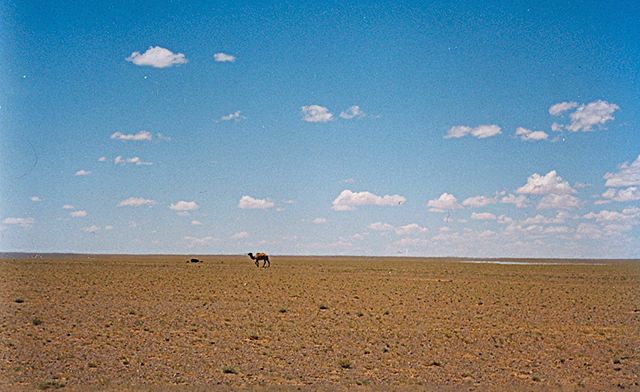
The Gobi Desert (or, by the end of this post, you’ll be glad I chose the camel image)

Edith Wharton, late in her writing career, wrote:

What is writing a novel like?
1. The beginning: A ride through a spring wood.
2. The middle: The Gobi Desert.
3. The end: A night with a lover.
I am now in the Gobi Desert.

I’ve been working on my novel-in-progress for just over a month, and just over 31,000 words. It’s hard to predict exactly how long it will turn out to be, but I can safely say that I am out of the spring wood … and I think I would know if I’d reached the night with an unidentified lover.

So this must be the Gobi Desert.

I don’t often watch survival-type shows—you know, Man Vs. Wild, Survivorman—because I am easily squigged out by survival. I can’t even think about 127 Hours (which I never saw) without having the impulse to curl up in the nearest corner and watch YouTube cats until the bad thoughts go away. But on the occasion I do end up watching something survival-related, a common theme shows up: keep moving. It makes sense. Unless you have the resources to set up long-term sustainable camp where you are, the longer you take, the more you expend.

This, I’ve found, holds for the novelist’s Gobi Desert, too.

It’s all about momentum, about keeping the story and the characters fresh and alive. Stagnation—true stagnation—has never helped anything. That’s not to say I subscribe to the write every day, without fail philosophy, because I don’t; I think stepping away to contemplate can be, at times, just as productive as actually putting words on the page. Sometimes we need to pause and think things through, because if we don’t, we might well end up with days, weeks of wasted work we could’ve avoided if we’d taken that time for thought.

I don’t need to write every day to make my way through the Gobi Desert, but I do need to have the writing on my mind every day. Even a few minutes, just to keep it present.

Of course, three hours of thought rarely gives the same satisfaction as three hours of writing, because there’s something wonderful about seeing that quantifiable progress. It often feels more valid, too. I can post on Facebook, I wrote two thousand words on my novel today! and my internet friends will understand at least to a point what that means, maybe even leave me little Yay! comments. But if I said, I spent two hours drinking tea and talking to my cats about my novel, I’d be lucky to get a lol.

It’s hard to measure the worth of contemplation, and I think that makes it easy to brush aside as a form of procrastination (which, don’t get me wrong, it sometimes is). But when you’re making your way through that Gobi Desert, you don’t do yourself any favors by charging boldly onward without stopping now and then to make sure you still have a sense of where you’re going and how you’re going to get there.

After all, what good is a night with a lover if you retire to the bedroom, begin to undress, and discover that your toes are purple with frostbite?

« Older posts Newer posts »

© 2026 Alice Thomsen

Theme by Anders NorenUp ↑