Alice Thomsen

on the wrong side of sunrise

Page 8 of 11

Titular Troubles

Confession: I am not good at titles. I often give projects filler “titles” so that I have something to call them, but since publication is a secondary concern for me right now, I go through most stories without having to commit to a title. I wrote a novel in the fall of 2005 that didn’t settle into anything for three years, and it wasn’t a stroke of creative genius—it was just the classic writerly strategy of keeping my ears open until I heard something worth stealing. My 2010 novel is still untitled, going by EMDASH—in part because it’s an acronym (Exsanguination Makes Death And Sadness Happen) and in part because I am, you may have noticed, rather fond of the em dash.

As I poke at the design for this site, I find myself needing to replace filler material with real material. This includes removing the photo of one of my cats lurking atop my bookshelf, settling on a color scheme, and coming up with a title.

My filler title was The Tiniest Writer (subtitle: Alice Thomsen) because although I’m in roughly the fiftieth percentile, height-wise, I was once part of a writing group where my stature inspired short jokes reaching new creative heights. (“Unlike your head!”) I gave in, embracing it little by little (“That’s how you do everything!”) because people say that once you start laughing at yourself for something, others will stop. This isn’t true, which, although disappointing, gave me an easy way to fill the blank in my site’s headline. (“It’s surprising you could even reach the top of the page without a step stool!”) But no more. I’m standing up for my five-foot-three-and-a-half-inch self and coming up with a real title.

Or, at least, that’s the plan.

You’ll notice that at the moment—depending when you’re reading this—the title is my name, with the subtitle writing with cats on the keyboard. I asked myself, What makes me unique as a writer? What sets my approach apart from that of every other twenty-something wannabe-novelist?
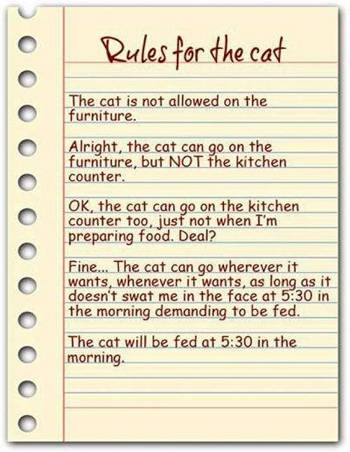
I have two cats. This list sums up our relationship, because my approach to cats is like my approach to short jokes: what happens will happen—just don’t fight it. What this means for my approach to writing, in turn, is that if a cat chooses to lie down across my arms while I’m typing, I’ll keep going, because hey, if I can’t reach that top row, I’ll just spell out the numbers, hold off on the em dashes, and make sure no one gets excited enough to need an exclamation mark. And if a house panther happens to take a path that goes over my keyboard, well, so be it—they say “Kill your darlings!” so it’s just as well I get comfortable using the DELETE key.

Does this give me writerly bragging rights? No. It doesn’t even give me crazy cat lady bragging rights—I think I’d need three cats to qualify for that. But it’s something, at least, and given that fiftieth percentile thing (“Maybe for hobbits!”) it’s probably more accurate.

A Place for Everything (and everything in its place)

In this final week before I embark on a new novel, I’m working to lay out a trajectory—get a sense of where I’m going and how I’m going to get there. Problem is, in ways, I don’t have much.

This project is different from others in that it’s grounded in place. Setting has never been a strength of mine, although I can’t claim I’ve given it due attention. Typically my settings amount to “nondescript city,” and outside passing references (to the weather, or traffic patterns at rush hour, or the bar where all the underage kids go to drink) it doesn’t come up. This, though … this is (literally) another story.

Several months ago, I read China Miéville’s The City & The City. We follow Inspector Tyador Borlú, a resident of the fictional European city of Besźel, which is mixed in with the city of Ul Qoma. Both occupy the same geographic space, more or less, with areas that are wholly one or the other and areas that are “crosshatched” blends of both, but they are politically separate, complete with a sort of border security and a customs office one must pass through to legally cross into the other city. Without this setting, the story (a murdered girl found dumped in a lot) becomes generic; with it, the story is deepened and complicated. Enriched. The City & The City could not take place in Anytown, Midwestlandia, or be transplanted to London; its development is predicated upon the complexities of Besźel and Ul Qoma, to the point where the cities become more than a simple backdrop.

So what of my upcoming project? Without going into details—something I don’t like to do before getting a first draft down—I can say that the story, like The City & The City, relies on location in an active sense. At least, it will, once I come up with it.

Beginnings and other messy notions

It’s a new year. It has been for eight days now, and I, like so many well-meaning people, am struggling to keep to resolutions. This is in part because my resolution is a very systemic one, amounting to develop a routine.

I do well with routines. Some of my most productive times have been very routine-based. The difference between those times and now is that those past routines developed naturally, whereas now I’m attempting to engineer a routine.

I’m entering what I hope will be my final semester of my undergraduate studies, this one primarily dedicated to finishing my second major in psychology. I have a final piece of my creative writing major to finish too, though, in the form of a Capstone project, an open-ended assignment meant to encourage individual and one-on-one work with a professor. Last year, I helped a friend of mine make a short film for his Capstone by plunging into a cold river to play a corpse. Now, I come up with something of my own.

It’s hard to ignore the thrill of a fresh start—a new year, a new semester, a new project, a new notebook, a new pen, whatever. Also hard to ignore, at least for me, is the pressure a fresh start presents. (My notebooks, for example, all have a blank first page, because I never know how to “dedicate” them and so skip to the second page to spare myself the stress of finding a worthy opening.) Starting a new anything can feel like being a small child who’s given a nice outfit and told, “Don’t get this dirty!” I’ve never understood the appeal of $236 Versace jeans for eight-year-olds. I’m supposedly an adult of some sort, and even I can’t be trusted to keep jeans from getting dirty, so maintaining the pristine condition of the new year? Daunting.

Only here’s the thing: It isn’t about keeping things pristine. It’s about finding your dirt wisely—or, if not wisely, deliberately.

At least, this is my theory.

Change of Plans

Previously, I made the reckless claim that I would lay out and demonstrate some of the ways I prepare to write a novel. I came up with five methods, but I’m realizing now that the approach I had planned to take in explaining these methods ignores a few key issues:

1. These methods often bleed into one another, rather than being discrete units.
2. They don’t fully represent my preparatory strategy.
3. Some of them, I don’t use.

As such, I’m going to scrap my previous plans. If you’re curious about the methods anyway, I made a page with brief discussion.

I’ll still be coming up with a novel concept of my own. Perhaps I’ll talk through my (much messier) actual process when that time comes.

« Older posts Newer posts »

© 2026 Alice Thomsen

Theme by Anders NorenUp ↑