on the wrong side of sunrise

Tag: reflection (Page 1 of 2)

Is this a pigeon?

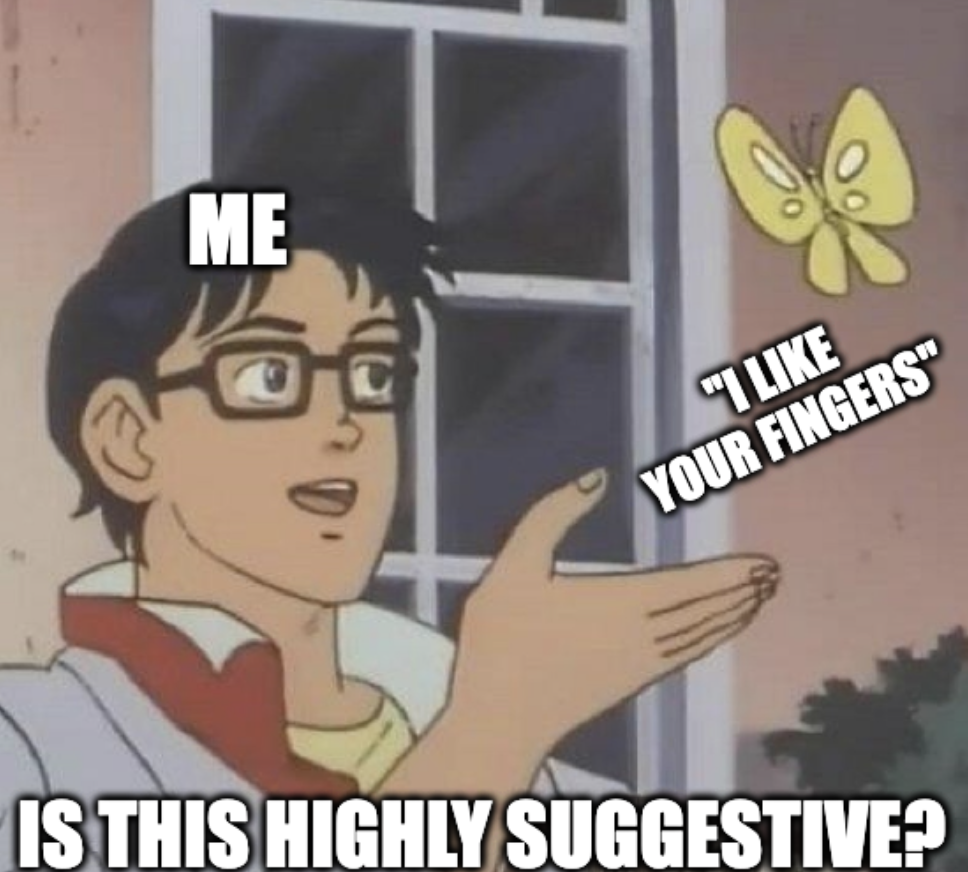
An anime boy wearing glasses and holding a book gesturing at a butterfly, which has been labeled with the following text: I like your fingers. He asks, is this highly suggestive?

A few months ago, I ditched X and swore off Meta. I briefly retrieved Instagram to message possible tattoo artists, but other than that and one Facebook post to say, “I’m still alive,” I’ve held to my (albeit modest) principles.

That said, I’ve been tempted. Facebook was my go-to for hivemind consultations—questions that don’t have a simple yes/no, or else have a technical yes/no that doesn’t feel quite right. I’m on Bluesky, but my network there talks about more serious things than whether an honor roll student earns “all As” or “all A’s.”

More than once, I’ve found myself wanting to say, “Hivemind, tell me—” and then realizing I cut off my own connection. (Boohoo, I know. Truly no one has given up as much as I have.)

Often when I try to write romantic or sexual tension, I think of what in my head is the “butterfly meme,” although cursory research will show the origin to be “Is this a pigeon?” You know the one, though, regardless; a man (the subject) holds out his hand to a butterfly (the actual thing) and muses, “Is this a [thing that it most certainly is not]?”

What I mean by this is that sometimes I just kind of write something and think, “I mean … that seems like how the allos probably do it, right?”
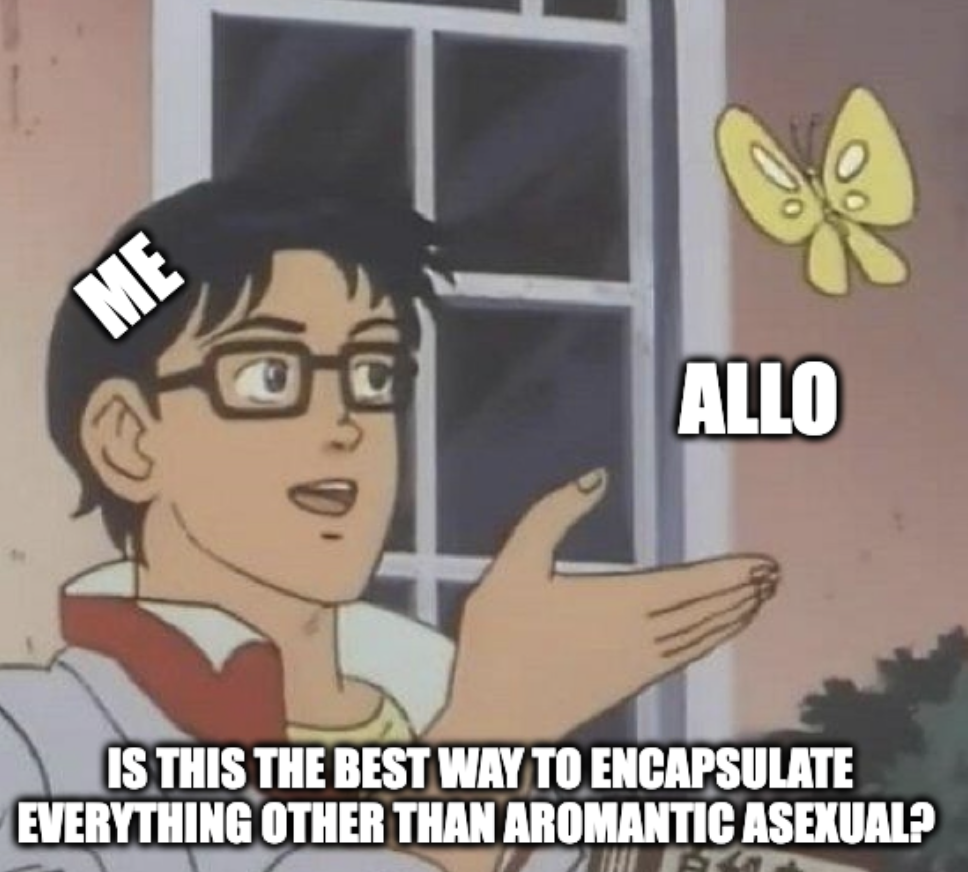
An anime boy wearing glasses and holding a book gesturing at a butterfly, which has been labeled with the following text: allo. He asks, is this the best way to encapsulate everything that's not aroace?

I used to get down on myself about it. “What, you can figure out how to write someone midway through a murder spree but not someone with a crush? Exactly how faulty is your wiring?”

Then I realized that it’s not that I’m good at the first and bad at the second; it’s just that it’s a lot easier to get away with being bad at the first. Even if we’re generous and say there are a full fifty active serial killers in the US right now, the chances of someone reading my novel while midway through a murder spree are spectacularly low.

Granted, given its unpublished status in combination with my near-debilitating inability to talk about it in any detail, the chances of someone with a crush reading it are also pretty low, but still. As far as potential angles for “Wait, does she really think that’s how it works?” scrutiny, that allosexual stuff is way more likely to get me in trouble.

This is all background for the real question at hand—which, incidentally, has to do with hands.

I have a character—let’s call her Jenny. (“But Alice,” you may be saying, “why are you making up a fake name for this person who is already fake, and who by now you should be very comfortable writing about directly?” And I would point you back to that thing I said four sentences ago about talking about the novel in any detail and how I’m bad at it.) Jenny has a partner, who we’ll call Greg. Jenny and Greg are consenting adults who are good friends and also have sex with each other.
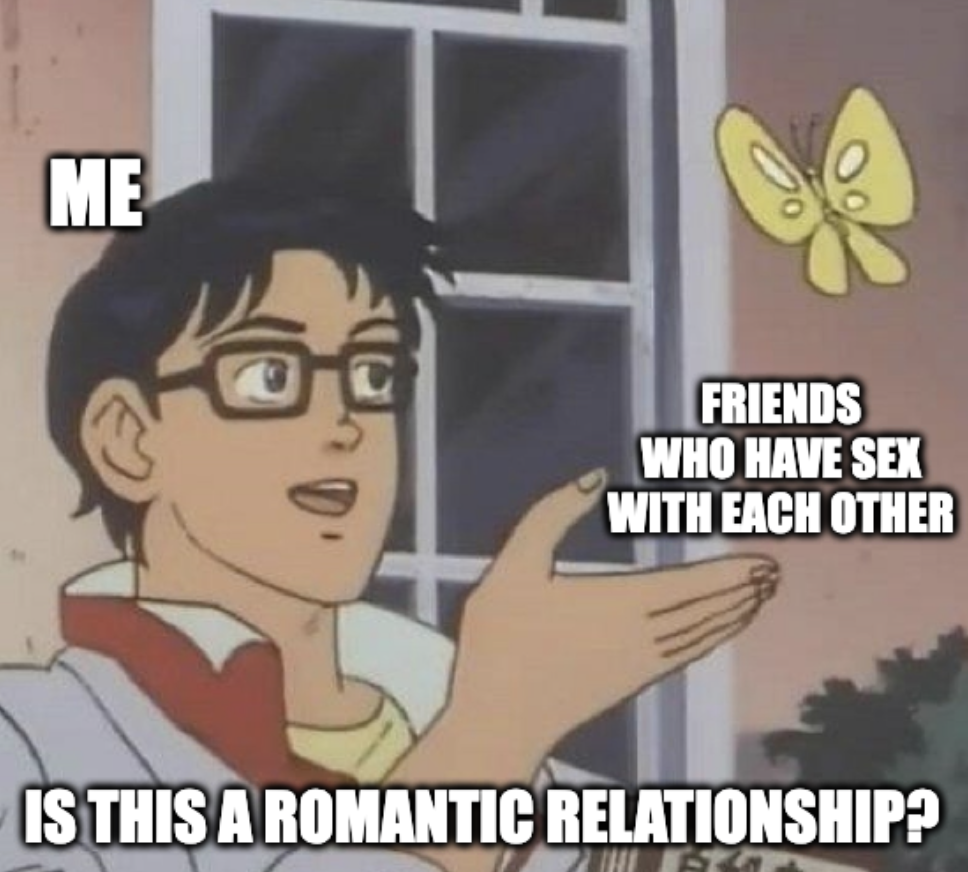
An anime boy wearing glasses and holding a book gesturing at a butterfly, which has been labeled with the following text: friends who have sex with each other. He asks, is this a romantic relationship?

Greg throws an ill-conceived punch and hurts his hand. Jenny expresses concern and says, “I like your fingers.” I move on with the story. Until, triggered by some chain of free associative ADHD cartwheeling, I think, “Oh, hmm.”

So, imaginary blog-reading hivemind, tell me—is it a pigeon? If it helps, here is a scale you can use:

1 – What about a pigeon?

2 – If you gave me a CAPTCHA with the prompt to click on all the suggestive lines, I might click this one, but I would save it for last.

3 – Ah, I see—because digital stimulation of the clitoris helps many people achieve orgasm.

4 – Sometimes an eggplant emoji is just an eggplant emoji, theoretically, but usually it’s not.

5 – You smut-peddling degenerate, are you really considering getting back on Facebook just to post this filth for review? You have neither ethical nor family values.

My Gen Z nephew just asked if I’m on Chat GPT, which I think means it’s time for me to stop tweaking this post and just publish it already.
Just Because

Disclaimer: I’m speaking as someone with an undergraduate degree in psychology and a bit of personal experience, not a licensed professional. Please don’t sue me—I can’t afford a lawyer.

Chemical depression is a bitch.

That’s not to say depression brought on by grief, trauma, change, stagnation, etc., is easy—depression in all its forms kind of sucks. The problem with chemical depression, though, at least for me, is that it turns me into a sponge for negativity, for pessimism and fatalism and surrender. We want things to make sense. Effects come from causes. Point B is preceded by point A. Every reaction has an equal and opposite action.

So if I’m feeling bad, something must’ve happened, right?

I was first diagnosed with major depressive disorder at twelve. The thing about kids is that their understanding of normal is shaped so heavily by their lived experience that they often don’t recognize trauma for what it is. A natural place for a therapist to start, then, is exploring that experience, casually probing for wounds the logical mind hasn’t recognized. I have long considered myself a resistant client, based on those early sessions, but the more I think about it, the more I suspect that I wasn’t trying to withhold—there just wasn’t much to say. I hit the birth circumstance jackpot: a stable, supportive family, where I never doubted my safety or basic needs, a well-funded school district with access to community resources, no major medical concerns, etc. Of course none of that precludes childhood trauma, and I had bumps here and there, but nothing I could point to as justification for the darkness.

I tried, though. I examined the world around me, looking for a source, something I could unpack and process. I adopted grief for a friend’s mother’s death; I manufactured guilt for a pet’s aging; I shifted the angle in looking back at the bumps to make them seem like mountains. Because these feelings were shallow, I could only delve so deep into them, but at the time, the lack of insight that followed my therapy sessions made them seem more intractable. In trying to make things better, I made them worse.

I hesitate to talk about all this, because my experience is atypical. In general, it’s bad practice, when a person says they’re feeling a certain way just because, to accept that there’s no deeper cause. We’re so socialized to the perfunctory How are you? of custom, not curiosity, that most people need a nudge to dip into anything of substance. Equally bad: when someone says they’re feeling a certain way because of something, to come back with skepticism, a raised eyebrow, an “Are you sure?” that’s dragged out just a little too long to be purely innocent. We’re told not to question the validity of emotions, and it’s a thorny matter to navigate questioning a professed cause without implicitly questioning its effect. So how can I look back on my years of failed therapy and say anyone did anything other than exactly what they should have?

Chemical depression doesn’t come out of nowhere. Still, if there’s a therapeutic model that focuses on motivating my brain to process neurotransmitters properly, I haven’t found it.

The kicker, of course, is that I don’t claim to be well-adjusted outside my depressive episodes. I have some pretty major hangups that impact my life in significant ways (e.g., writerly insecurity so overbearing that, on the occasion I feel confident enough to consider something so presumptuous as thinking about one day trying to publish a novel, I Google literary agents in Incognito mode so someone checking my search history won’t realize how overinflated my ego is) and some life circumstances whose emotional impact I need to sort out (e.g., grieving the loss of a found family). I could absolutely benefit from therapy, and I occasionally have—it just never happens when I’m in a depressive episode, when it should ostensibly be most advised.

I guess the takeaway here, to tie it back to this blog’s loose theme, is that we don’t develop the same way characters do. We can’t always write a backstory to make ourselves make sense. Sometimes the narratives we create can be productive … but sometimes the temptation to find a narrative overwrites the messy, often dissatisfying reality. Maybe that explains some of the correlation between mental illness and writers—the urge to make meaning seeks an outlet, one way or another. There’s little resolution to be found when the answer is just because, but in fiction, we can fix that in revision.

What Big Teeth You Have

I’ve mentioned before the fiction workshop I’m taking this semester, specializing in linked stories. (If you want to follow along with the course, check out our class blog.) The basic idea of linked stories is that they’re too connected to be wholly separate stories and still have the same impact (that is, they function as stories alone but become more powerful in combination) but too distinct to be a novel(/novella). If this sounds like a slippery definition, that’s because it is. There’s a whole messy space between collections of unrelated stories and novels that’s inhabited by linked stories, story cycles, novels in stories, composite novels, etc.

I took something of a hiatus from writing anything complete from 2003–2005 (during which time I considered, among other things, becoming a high school band director) and picked it back up on a whim when a friend of mine instructed me to do NaNoWriMo. (I do mean instructed. There was no, “Hey, I’m going to do this thing. Want to do it with me?” There was only, “Do NaNoWriMo.”) It was a messy month—I came up with my concept at the last minute, realized when my planned plot concluded that I only had half of the 50,000 words, and only finished because Thanksgiving Break afforded me the opportunity to lock myself in the bathroom, away from distractions, and pound out 7,000 a day. But I finished a project that I lovingly called the SVN, because titles have never been my strong suit.

The SVN involved five different viewpoint characters, and although that messy first draft didn’t make the best use of them, by the time I’d been through several revisions (for three years, although I had other side projects, it was my focus) each of those characters had an arc, all of which converged in the penultimate scene.

In other words, the SVN could, in a way, be considered a collection of linked stories, interwoven with one another.

I wrote another NaNoWriMo novel in 2008 (my next serious project) that had two viewpoint characters who spent the majority of the plot not knowing of each other, much less their connection. Again, their arcs joined up as the story neared its end; again, I could rephrase that as, their stories joined up as the piece neared its end.

My current project is a single viewpoint chronological narrative—free of murkiness—but it occurred to me that it’s the exception. Of the novels/sort-of-novels I’ve written, almost three-quarters have been, to some extent, separate but linked stories.

That said, they’ve all be much closer to the novel end of the spectrum. There are separate character arcs, but they’re all structured around the central conflict, whatever that is, and even when the characters don’t yet know each other, it’s clear to the reader that they’re all directly tied to that conflict, so they’re only ever as distant as a friend of a friend(/enemy of an enemy, etc.). I consider those pieces to be novels … but I suppose it’s rarely quite so simple.

I’ve adamantly defended my novelist identity; the idea that I might be dipping so much as a toe into that murky in-between water seemed, until about 3:15 this afternoon, impossible. It’s disconcerting. Because Continue reading

Pulpy Marshmallows (or, how I became an embittered novelist)

I’ve said it before; I’ll say it again. Cathy Day is the reason I applied to the graduate program I started today, and although she isn’t the sole reason I picked it over the others that accepted me, she is a big one. This semester, I’m taking a fiction workshop with her, and in preparation, I read this.

I was going to quote some passages, but then I realized I wanted to quote the whole thing, so instead, just go read it. Seriously. I’ll wait.

Back? Okay. Still here, because you didn’t actually go read it? I’m not kidding. GO.

Now that you’ve read it, let’s talk. My writer friends will back me up on this: I hate short stories with a passion that borders on pathological. (Okay, they might not say borders.) If pushed, I will grudgingly admit that now and then, I do come across a short story I enjoy, and I have written a few that I found tolerable, but those are the exceptions. I hate short stories.

So when Day writes, as you recall, “I know without a doubt that when I was growing up, I absolutely loved to read novels and rarely read short stories unless they were assigned in a class,” I’m with her. It’s #9, though, Writing Right-handed vs. Left-handed, that really got me.

Sometimes a left-handed novelist is wise or stubborn enough to realize that he is not a right-handed story writer with horrible penmanship, but more accurately a beautiful left-handed novelist with perfectly fine penmanship. When he is alone, away from school, he brandishes the pencil in his left hand and sighs. Ahhhhhh. Then in college, he takes a workshop, which is full of nothing but right-handed desks. He puts the pencil in his right hand. Out of necessity, he’s become ambidextrous. And so, he goes through the motions of writing right-handed short stories for class. Assignments that must be completed. Hoops to jump through so that he can be in this class, read books for credit, and get a degree in the writing of fiction. At night, he goes home and puts the pencil in his left hand and works some more on his novel, the pages of which he never submits to his teacher, whose syllabus clearly states that they are to submit short stories that are 8-15 pages long.

If I had a dollar for every time I’ve called short stories a hoop to jump through, I could buy so many more cereal marshmallows than one person needs. And then I could eat homemade Lucky Charms, gnashing my teeth and enjoying the bitter fantasy that the marshmallows were made of the pulped pages of short stories (which, let’s be honest, is plausible).

That’s the key: bitter fantasies.

When I was eleven, I wrote my first novel-of-sorts. It was a hundred-something pages, and I entered it in our local 4-H fair. The rule book didn’t have a page limit for creative writing submissions. I checked.

Come show day, I plopped my binder on the table in front of the judge. She looked the size of it, read the first paragraph, and gave me an honors ribbon that I knew had nothing to do with the quality of my work.

The next year, the rule book specified a ten-page limit. I brought in the first chapter of my new novel-in-progress. Suffice it to say that the year after that, they also instituted formatting requirements.

It’s always been that way. When I want to have the work I care about read, the Powers That Be won’t read it, so instead I put forth work that, to be honest, I don’t really care about. I get grades (which are what count) and feedback (which I file away, in case at some point I need, say, application material) and go back to what I do care about.

There are things fiction writers can learn from poetry. It’s the same line I hear when I say I want to be a novelist, and it’s true—there are things a novelist can learn from short stories. Still, my poetry-focused undergraduate program left me feeling adrift, alone, and embittered, and my short-story-focused education has left me the same way.

I’ve been lucky to have friends and family who have been supportive and interested in my real work. But am I really just spending thousands of dollars and years of my life in the hopes of jumping through enough hoops that one day I can get a couple letters after my name to identify me as a Real Writer, then go be a novelist in peace?

I think not. I hope not. My graduate program is not well-suited to novel writing, and I knew it wouldn’t be, just as I know my professors don’t have the resources to work with me on a novel. Wednesday, though, I start that fiction workshop. We’re focusing on linked stories. It’s not novels, no, but you read the article—I don’t have to tell you that it’s a sign that somewhere out there, there exists something bigger than the standalone 8–15 pages.

Audience Awareness: a confession (featuring only one link to an external reference)

Here’s something you might not know about me. I’m actually a decent singer. Not outstanding—my range isn’t great, and I’m not one of those people who can instantly harmonize—but competent. I played assorted woodwind instruments for almost ten years, so I’m good at breathing (sounds easy, but often overlooked) and since I often played complementary rather than primary parts, once I find a harmony, I can stick to it.

Like I said, competent.

But there’s a reason you might not—almost certainly do not—know this about me, and it’s this: I don’t sing around other people. Occasionally, if I have a bit of liquid alcohol—I mean, liquid courage—and surroundings where it could easily pass undetected, I might let out a few lines, but don’t hold your breath for it. (Seriously—don’t. Good, deep breaths are important if you want to get more than three words in to “All the Small Things,” which—if you didn’t know—drunk girls are unable to resist singing if it comes on.)

I am, as you might well guess, somewhat self-conscious and insecure.

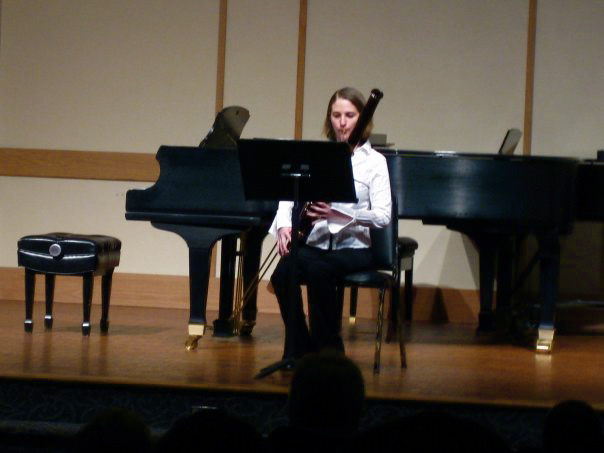
It isn’t just singing, though. This is a fault of mine that colors most of my pursuits, and it’s problematic. There are times when I handle it better—for instance, in my first year of college, I performed an unaccompanied bassoon solo at a recital. It was the fourth of Telemann’s twelve Fantasias, and I infer from the lack of nightmare flashbacks that the performance went all right.

Still, even though I have my moments, I don’t have many of them, and those I do are typically well-rehearsed—hours of practice in private lessons or alone, then on the stage in an empty auditorium, maybe—and fact-checked. This, I realize, might not be a good way to approach the world.

I recently began submitting applications to graduate programs, and many of them request a resume or curriculum vitae. In both cases, I list this site, and given that, I think I need to find a way to get back into updating and designing it. I have a couple ideas as to how to go about this, but one question I’m torn on is attention to audience. Do I take into consideration everyone who might possibly come across my blog—an old friend who moved away when we were eight, Googling my name out of curiosity? a second cousin I’ve never met? the director of a graduate program going through my application?—or do I post without thinking of them?

In Stephen King’s book On Writing (okay, two external references) he discusses your Ideal Reader. It’s been over ten years since I read the book, so I don’t want to go into too much detail, at the risk of misrepresenting King’s concept, but here’s the essence of it. Your Ideal Reader is who you think of when you think of your audience. The common sentiment goes, if you try to please everyone, you’ll end up pleasing no one, and I think this is the function of the Ideal Reader—to provide someone, real or imaginary, to write to.

I made a previous attempt at blogging before, with even less direction than I have now, but in those early posts, I addressed my Imaginary Readers, operating on what I thought was a similar philosophy. That misses the point, though. The Ideal Reader is a single entity, one who is well-defined in the mind of the writer; Imaginary Readers are a nondescript group of unknowns, and as a result, an attempt to appeal to them is doomed to fail.

My Ideal Reader is less defined than it once was. I suspect this is part of what has frozen me up with regard to my blog—I get flustered by considering all the potential readers.

This website will be getting redesigned over the coming weeks and months, and with that, I hope to alter my approach to blogging so that it is less self-conscious and less insecure. We are in a period of transition, my Ideal Reader and I. The times, they are a-changin’.

(Okay, three references, but none of them is a peer-reviewed study. I think that counts for something.)

« Older posts

© 2026 Alice Thomsen

Theme by Anders NorenUp ↑