on the wrong side of sunrise

Author: Alice Thomsen (Page 4 of 11)

Lions and tigers and … well, just lions, actually.

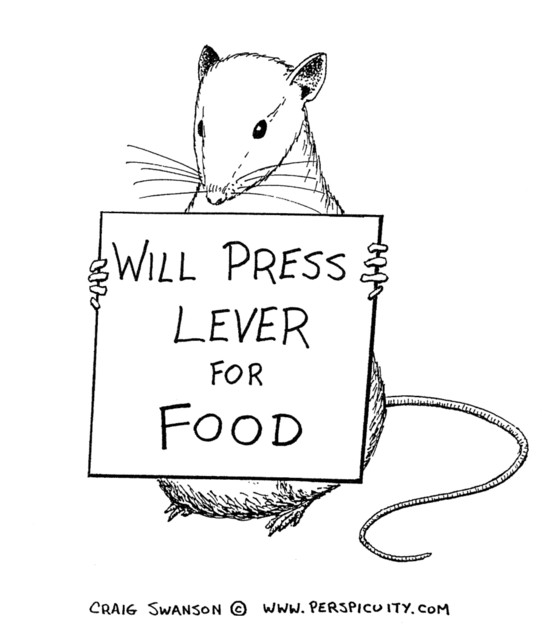
Operant conditioning relies on consequences—punishments and reinforcers—as a means of either decreasing or increasing a subject’s likelihood of repeating a behavior. Punishments decrease; reinforcers increase. Both come in positive and negative—either adding or removing something.

So:

  • You steal my toy, and I punch you, so you’re less likely to steal it again. This is positive punishment.
  • You steal my toy, and I stop talking to you, so you’re less likely to steal it again. This is negative punishment.
  • You share your toy with me, and I share one of mine in return, so you’re more likely to share it again. This is positive reinforcement.
  • You share your toy with me, and I stop whining for you to share it with me, so you’re more likely to share it again. This is negative reinforcement.

I have, you may be able to tell, been thinking a lot about motivation lately.

Here’s the thing. Fear is a powerful motivator. Fear—justified and otherwise—is a driving force in society. Fear is a useful adaptation—it helps us survive. Fear says, “Don’t mess with that lion. It could probably maul you.”

Fear is a product of punishment—either directly or by proxy. I can take a lesson from seeing what happens to a zebra who gets too close to that lion. Fear pushes us to avoid bad things, and that’s a healthy quality.

But fear isn’t enough. Fear may prevent mauling, but it won’t promote greatness. That’s where reinforcers come in.

I see this a lot—in myself and my peers, in writing and work and relationships and life. Fears of failure, of judgment, of rejection—they drive us to seek safety. We write what is least risky. We stay by the trunk, way back from that limb, or maybe out of the tree altogether. All manner of beasts could be loitering up there.

And because of this, we are not great. Fear motivates survival and not much else.

I’ve talked before about motivation through the lens of incentivizing preschoolers, so I’m going to take it back another level (and see how far I can go before being accused of condescending and over-simplifying). A common tenet of dog training is that “positive reinforcement is one of your most powerful tools.” By reinforcing rather than punishing, you show a dog what behaviors you want, rather than leaving him to figure it out by process of elimination. (I’ll let you come up with your own house training joke for that one.)

Punishment motivates fear. Reinforcement motivates desire.

For writers, rejection is in no short supply, even if we’re not submitting work for publication. We can apply to programs or workshops and receive the stock thanks-but-no-thanks that sometimes comes with a note of regret, mentioning the high number of applicants and the limited number of spaces and how many talented writers are being turned away, as if any of these things make the NO any less NO-like. We can share a piece with a reader whose opinion we trust and get a response that is lukewarm only out of consideration for our fragile egos. We can finish a draft and feel good, then return to it two weeks later and find it appalling. Even the most introverted of us are still human, and humans are social beings, and to a social being, rejection is one of the worst punishments out there. (Rejection by other humans, at least. There’s a certain relief in being turned down by the aforementioned lion.)

This, I think, is why it’s so vital for us to find writing intrinsically rewarding, so that it becomes a reinforcer on its own. For all our insecurities, writing requires a degree of arrogance, and it’s one we have to embrace. We have to believe that what we do has value, that when we tell ourselves, “Sit, writer!” and plop down at our desks, we’ll get a Milk Bone of positive reinforcement. Or, if Orwell is right, and “Writing a book is a horrible, exhausting struggle, like a long bout with some painful illness. One would never undertake such a thing if one were not driven on by some demon whom one can neither resist nor understand,” then perhaps we’ll receive negative reinforcement in the form of some relief, however momentary, from that demon.

(Note: One could mistake this for positive punishment, in that the demon punishes a lack of writing, but operant conditioning deals with the consequences of actions, not inaction.)

Either way, if we work from a place of fear, we may survive—it’s not guaranteed, but it’s the best we can hope for; if we act from desire, we’re not guaranteed success, but at least we’ve got a chance at it.
There’s a bathroom on the right.

There’s a new category on the right end of the navigation bar up top. See it over there, “Teaching“? Yeah. It doesn’t have much content at the moment, but it will be developing over the next couple weeks as I put together my teaching portfolio. It will include, among other things, a syllabus for the ENG 104 courses I’ll be teaching next semester. When I first expressed anxieties about teaching, people told me, “But you’re so good at grammar! You’ll be great.” While it’s true that I know my way around comma rules, I’m still working on learning my way around the classroom—but I am learning and beginning to find the prospect of being in charge of a whole roomful of students a bit less preposterous.
In other news, a short story of mine was recently accepted by The Broken Plate for the 2014 issue. The story is called “Rest In Peace” and features an autobiographical moment of mondegreen—what Wikipedia explains as “the mishearing or misinterpretation of a phrase as a result of near-homophony, in a way that gives it a new meaning.” Or, put more plainly, it’s the “bathroom on the right” effect:

The chorus actually goes …

Don’t go around tonight.
Well, it’s bound to take your life.
There’s a bad moon on the rise.

Alternatively, though, you might hear it as …

Don’t go around tonight.
Well, it’s bound to take your life.
There’s a bathroom on the right.

And hey, if that’s the version you prefer, more power to you. I won’t try to correct you—unless you neglect to set off that exclamatory “well” with a comma.

Week 7: Chapters vs. Stories, Part III, Section B

This is the second of two posts (first one here) from my linked stories class. Now, we’re going to talk about Cambria, PowerPoint, and our second class activity.

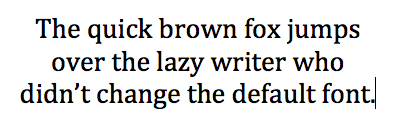
So let’s backtrack for a moment to early in the class period. We discussed formatting—for our upcoming projects and for fiction in general. Prof. Day advised us not to use Cambria, which is the default font for Microsoft Word. (I’d take it one step further and say don’t use Word, but that’s another matter.) Many of Word’s settings are better changed because, as she put it, “You’re the boss of Word!”
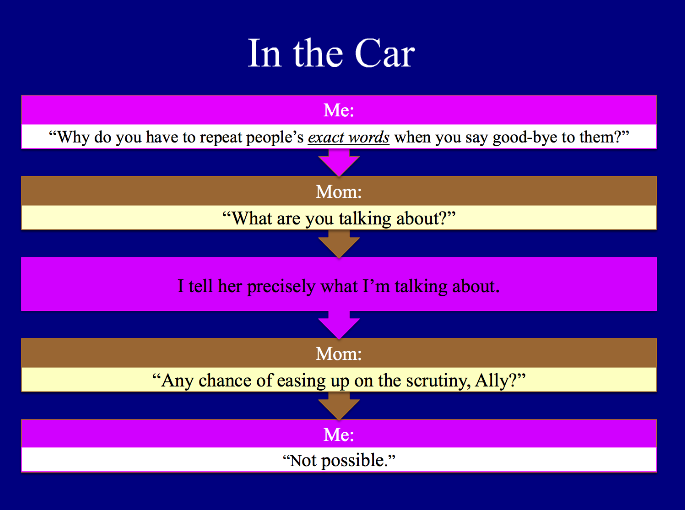
I don’t know about Jennifer Egan’s relationship with Word, but I can tell you right now that she is the boss of PowerPoint.

Our Activities, Part II: Translating PowerPoint to Normal Story

As I mentioned last time, Chapter 12 of Goon Squad, “Great Rock and Roll Pauses,” is told entirely in PowerPoint slides. The fictional slidemaker, 12-year-old Alison, reveals a portion of her family life, including her brother’s obsession with the pauses in songs.

It’s hard to discuss how this piece works without having read it, so if you didn’t click the link earlier, go now. It’s a quick—and unique—read. Of it, Egan says,

Goon Squad is a book about time, composed of 13 discrete stories separated by gaps. And PowerPoint (or any slideshow, it doesn’t have to be Microsoft) is a genre composed of discrete moments separated by gaps. As a genre, it echoes the structure I was already working with in Goon Squad, and its corporate coldness allowed me to be overtly sentimental in ways I probably wouldn’t have allowed myself to in conventional fiction.

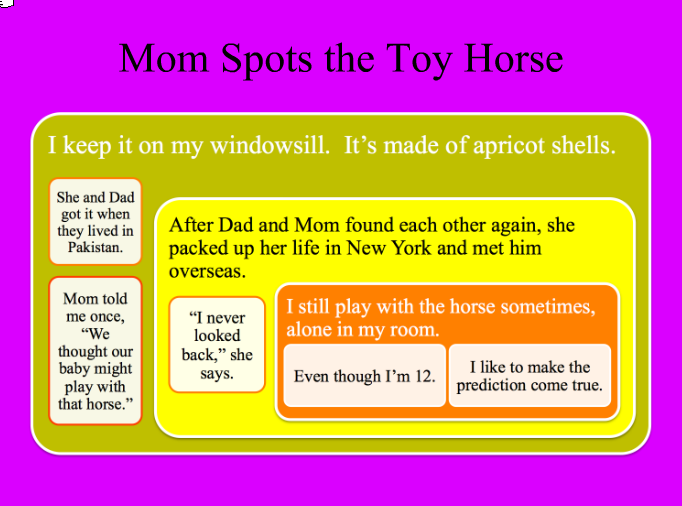
Our task, having read this chapter, was to take a ten-slide portion of it and translate it into “conventional fiction.” Some slides make it pretty easy by being single linear exchanges:

All slides © Jennifer Egan

Some make it more difficult by being nonlinear in form and all over the place in time:

Some just can’t be captured the same way in “normal story”:

And some are simple statements of fact:

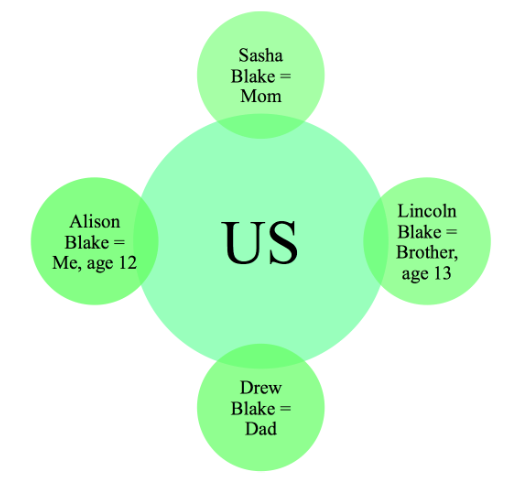
Although we grappled with the nonlinear ones, these last, factual ones seemed to give us the most difficulty—we didn’t feel free, as Prof. Day put it, to “transform the data into good fiction” and so tried to do a too-literal translation. (As any foreign language study will show you, a literal translation of anything complex is rarely successful.) It’s a common problem even when we’re not translating from PowerPoint, though. How do we convey information without just resigning to the dreaded “info dump”? What do we do with that green-circle slide, other than turn it into a list of dramatis personae?

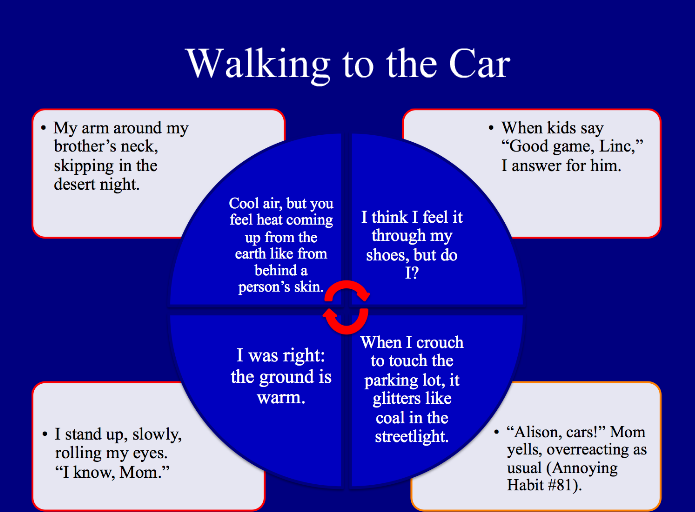
For starters, recognize that we can work it in over time. Take the fifth slide:

My translation went like this:

We’re walking to the car, skipping in the desert night. My arm is around my brother’s neck, and when kids say, “Good game, Linc,” I answer for him.

It’s cool air, but you feel heat coming up from the earth like from behind a person’s skin. I think I feel it through my shoes, but do I? When I crouch to touch the parking lot, it glitters like coal in the streetlight. I was right: the ground is warm.

“Alison, cars!” Mom yells, overreacting as usual (Annoying Habit #81).

I stand up, slowly, rolling my eyes. “I know, Mom.”

So, for instance, I might have referred to the junior high baseball league to approximate Lincoln’s age, and called him Alison’s older brother. I might have remarked on the father’s absence from the game to show that he’s also an important character, even if he isn’t in this scene.

It’s a good exercise, considering how you might translate these things. If you’re following along but haven’t been keeping up on the activities, try this one. Give yourself the same ten-page assignment and see what you come up with. (Leave it for me in the comments, even—I’m curious.)

What’s next?

For us, we’ll be kicking off workshops soon, looking at material for our final projects. For you, you can kick off a workshop as well. Find a writing group near you, or start one, or seek out an online community. Share what you’ve learned by following our class, and exchange stories. In other words, make links.

I am linking. Are you?

Week 7: Chapters vs. Stories, Part III, Section A

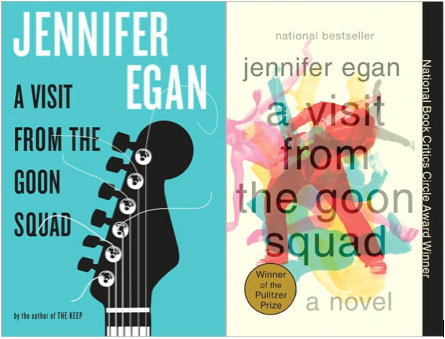
This week marks the more-or-less midpoint of my linked stories course with Cathy Day, and the last of our reading-focused classes. (Up next: workshops.) We started the semester with the least linked stories, Short Cuts, and worked our way toward more and more tightly linked pieces, finally reaching today’s book, A Visit from the Goon Squad, whose second-edition cover identifies it as a novel.
To my regular readers: This will be a stylistic departure. I’m preparing this post as the first of two to be shared on our class blog, where you can follow along with us.

To my new readers: Hi. My name is Alice, and I’m here to talk to you about …

What We Read: A Visit from the Goon Squad

A Visit from the Goon Squad is the result of Jennifer Egan‘s challenge to herself to write a book with chapters “as different from each other as possible, yet still adding up to one story.” (source) After an interview with Egan, Emma Brockes observes,

The idea for Goon Squad came to her after her reading group got stuck into Proust. It took them about seven years to plough through In Search of Lost Time, during which she became obsessed with how to represent entire lifespans, non-sequentially and in the way people actually experience them, that is as a constant negotiation between reflection and anticipation.

The twelfth chapter of Goon Squad is written as 12-year-old Alison’s autobiographical slideshow, complete with sound effects (if read online, as was Egan’s initial expectation). Another story is told in second-person. Still another is a news article. Different narrators, different protagonists from one chapter to the next, different time periods over forty-some years—and now identified as a novel?

Our Activity: Reorganizing Goon Squad

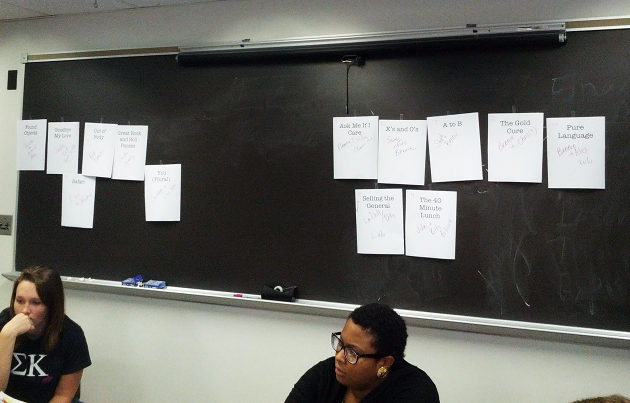
Because of the delightfully mixed-up nature of this book, an obvious exercise is to experiment with different ways of ordering the chapters. What would happen, for instance, if we extracted all the chapters that prominently feature Bennie? Or Rob’s death? What if we put them in chronological order as best we can?

Pictured: Kate Gutheil and Ashley Mack-Jackson with chapters sorted into character-based arrangements

(A past, particularly ambitious reader had done something like this already. Tyler Petty went through the book and outlined the timelines for twelve different characters.)

As we reflected on this task—the difficulties in mapping out an exact timeline, the costs of every rearrangement—someone declared that Egan had already put it in the best order. Prof. Day said, “I know.”

Takeaways

The order of chapters/sections/stories in a book goes a long way in determining how it’s read. Chronological Goon Squad, for instance, doesn’t have the same emotional effect, because information gets doled out differently. Good Squad organized by major character loses the interwoven, interdependent feel.

That doesn’t mean, of course, that a more conventional structure is always bad. It just means that organization should never be taken for granted, that we shouldn’t default to one form because that’s how it’s usually done (or for the sole purpose of being different) without thinking about how it will serve the book we’re writing. We need to take time for these questions, to make these decisions deliberately, open to the possibility that the first way we try it might not be the best. (We also have to recognize that there are Tyler Pettys out there, so if we’re going to play with chronology, we better make sure we double check our math.)

What I Learned

I’ve experimented some with chronological deviation in novels and written chronologically-ambiguous short stories, mosaics of scenes whose temporal relations aren’t explicit but are clearly not chronological. But I haven’t written—or contemplated in-depth—something with the scope of Egan’s book. The questions and considerations presented by a project like Goon Squad are fascinating (if somewhat daunting). The most important thing, though, was that reminder that no decision should be taken for granted in writing, and that there are questions worth asking that I might not think of at first.

What’s next?

In a few days, I’ll share the second half of our class activities, which focused specifically on that twelfth chapter.

Something in that I don’t like.

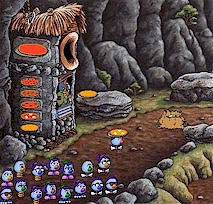
When I was young, I played a computer game called Logical Journey of the Zoombinis. I don’t remember much about it, except that the goal was to successfully navigate bands of Zoombinis from one side of a map to another, solving logic puzzles to avoid perils along the way.

One of those puzzles requires you to suss out the pizza preferences of a couple troll-like creatures. You offer them different toppings in combinations until they’re pleased. Until they’re satisfied, they’ll respond to your offers with either, “More toppings!” or, “Something on that I don’t like,” flinging the pizza away in rejection.

Screw up too many times, and your little Zoombini server gets booted out of your party.

In related news, I recently read Sideways, by Rex Pickett.

I recently read Sideways and, on several occasions I found myself with an urge to fling the book away and declare, “Something in that I don’t like!” That something, I realized quickly, was the characters.

I’ve read plenty of books with central characters I disliked, though, and I wasn’t always struck by the urge to fling them away … which makes me wonder what, exactly, that difference is.

There are all sorts of reasons I dislike people, some of them more legitimate than others, so perhaps that’s part of it—different characters are unlikable for different reasons. I enjoy a charming sociopath, for instance even if the sociopathy outweighs the charm and I don’t actually like the character. Perhaps the most striking example from my recent reads is Horns, by Joe Hill. There are a few characters whose heads we get to inhabit, and none of them are particularly likable—one of them, in fact, becomes something akin to the devil. Yet I enjoyed the book, to the point that I’ve recommended it to several friends.

Those Sideways characters, though. They have inspired me to warn several friends away from it (or else assure people who meant to read it before watching the film adaptation that really, they didn’t miss anything).

The New York Times recently published a pair of short essays by Moshin Hamid and Zoë Heller on the matter of unlikable characters. Hamid observed:

I’ll confess—I read fiction to fall in love. That’s what’s kept me hooked all these years. Often, that love was for a character: in a presexual-crush way for Fern in “Charlotte’s Web”; in a best-buddies way for the heroes of “Astérix & Obélix”; in a sighing, “I wish there were more of her in this book” way for Jessica in “Dune” or Arwen in “The Lord of the Rings.”

Then, though, he goes on to note that, “In fiction, as in my nonreading life, someone didn’t necessarily have to be likable to be lovable.”

It’s an important distinction, likable vs. lovable, and one that—in different ways—we’re all familiar with. It’s like that line that gets floated around in different fonts, superimposed over different images: At some point you have to realize that some people can stay in your heart but not in your life (or some variation thereof). We’ve all been there, loving something that was not, by objective measures, good—a person, a behavior, a life state, whatever. But goodness—likability—isn’t the primary criterion we use sometimes.

Few would argue in defense of Dr. Lecter’s dietary preferences. And yet we love him. Or, at least, I do.

So what’s a writer to do with this? Likable might not be good enough to be lovable, and unlikable still needs to leave room for lovable.

The short answer is, I’m not sure. Writing always has an element of trial and error, the same as in real life. I can list off characteristics of people I love (in a broad sense) and although that’s a start, it doesn’t mean I’ll love everyone who meets those criteria—or that I won’t love anyone who doesn’t. I have to actually interact with those people. Still, here are some points I would put out:

  • a lovable character has agency (we can pity a victim, but pity isn’t love)
  • a lovable character wants something (otherwise it’s just a lazy afternoon with an echoing, “I dunno, what do you want to do?”)
  • a lovable character makes decisions (we, as readers, are along for the story’s ride; we need more from a character)
  • a lovable character faces a genuine but potentially surmountable obstacle (if it’s all smooth sailing, or if there’s no reason to hope, we have nothing to wonder about, and wonder is a key component of love)

That’s an imperfect list, of course. (You’ll notice that much of it has as much to do with story as with character. Separating the two seems, in ways, a pointless exercise, because one without the other loses either its context or its importance. But that’s another matter entirely.) If you have any to add, leave me a comment.

« Older posts Newer posts »

© 2026 Alice Thomsen

Theme by Anders NorenUp ↑