on the wrong side of sunrise

Tag: novels (Page 2 of 3)

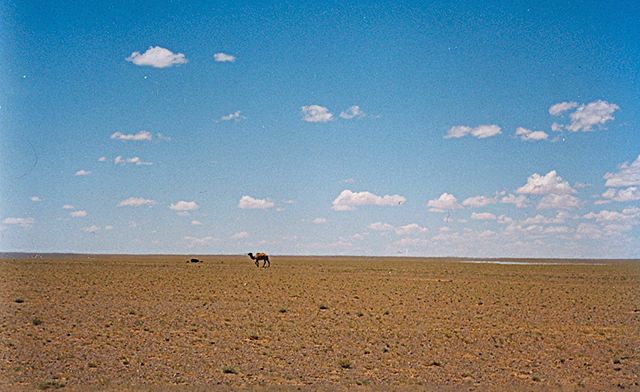
The Gobi Desert (or, by the end of this post, you’ll be glad I chose the camel image)

Edith Wharton, late in her writing career, wrote:

What is writing a novel like?
1. The beginning: A ride through a spring wood.
2. The middle: The Gobi Desert.
3. The end: A night with a lover.
I am now in the Gobi Desert.

I’ve been working on my novel-in-progress for just over a month, and just over 31,000 words. It’s hard to predict exactly how long it will turn out to be, but I can safely say that I am out of the spring wood … and I think I would know if I’d reached the night with an unidentified lover.

So this must be the Gobi Desert.

I don’t often watch survival-type shows—you know, Man Vs. Wild, Survivorman—because I am easily squigged out by survival. I can’t even think about 127 Hours (which I never saw) without having the impulse to curl up in the nearest corner and watch YouTube cats until the bad thoughts go away. But on the occasion I do end up watching something survival-related, a common theme shows up: keep moving. It makes sense. Unless you have the resources to set up long-term sustainable camp where you are, the longer you take, the more you expend.

This, I’ve found, holds for the novelist’s Gobi Desert, too.

It’s all about momentum, about keeping the story and the characters fresh and alive. Stagnation—true stagnation—has never helped anything. That’s not to say I subscribe to the write every day, without fail philosophy, because I don’t; I think stepping away to contemplate can be, at times, just as productive as actually putting words on the page. Sometimes we need to pause and think things through, because if we don’t, we might well end up with days, weeks of wasted work we could’ve avoided if we’d taken that time for thought.

I don’t need to write every day to make my way through the Gobi Desert, but I do need to have the writing on my mind every day. Even a few minutes, just to keep it present.

Of course, three hours of thought rarely gives the same satisfaction as three hours of writing, because there’s something wonderful about seeing that quantifiable progress. It often feels more valid, too. I can post on Facebook, I wrote two thousand words on my novel today! and my internet friends will understand at least to a point what that means, maybe even leave me little Yay! comments. But if I said, I spent two hours drinking tea and talking to my cats about my novel, I’d be lucky to get a lol.

It’s hard to measure the worth of contemplation, and I think that makes it easy to brush aside as a form of procrastination (which, don’t get me wrong, it sometimes is). But when you’re making your way through that Gobi Desert, you don’t do yourself any favors by charging boldly onward without stopping now and then to make sure you still have a sense of where you’re going and how you’re going to get there.

After all, what good is a night with a lover if you retire to the bedroom, begin to undress, and discover that your toes are purple with frostbite?
Scapple

Last time, I talked/gushed about Literature and Latte’s application Scrivener. Not so long ago, I decided to try out another program of theirs, Scapple.

The basic premise: Scapple lets you put down ideas, make connections between them, shift them around, and more. Literature and Latte describes it as a “freeform text editor” and explains,

Scapple doesn’t force you to make connections, and it doesn’t expect you to start out with one central idea off of which everything else is branched. There’s no built-in hierarchy at all, in fact—in Scapple, every note is equal, so you can connect them however you like.

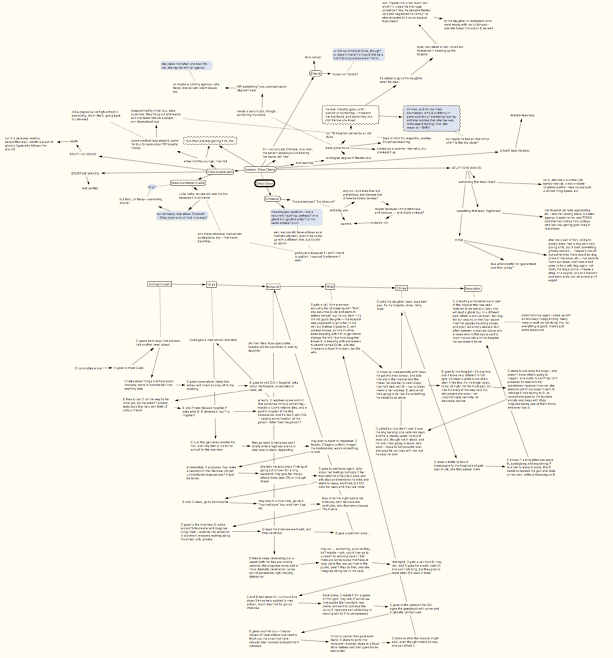
I tested it out in the early stages of prep work for the novel I’m working on (the ghostless ghost story I mentioned a few months ago). Here’s the end result, zoomed out to show the whole thing:

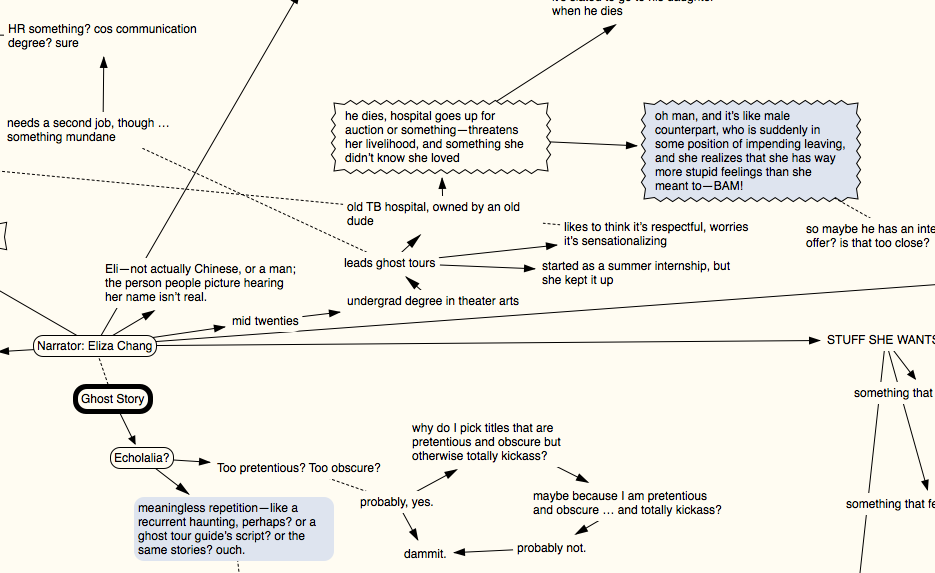
And here’s a smaller section that’s actually legible:

About five years ago, I went through a phase of freeform brainstorming a little like this. I had a big pad of newsprint paper (something like this) and a pack of these multi-colored markers, and I’d sit on my dorm room floor, writing down different questions and answers about the project in different colors and orientations. I fell out of the habit, but working with Scapple reminds me a bit of that. The primary difference, of course, is that my marker notes couldn’t be rearranged, connected and disconnected and changed to a different color.

So, Scapple. What can I say about Scapple? I haven’t used it much beyond what’s above, so I can’t speak to/gush about it to the same extent I can Scrivener. I wouldn’t say I’ve fallen in love with it yet, but it was certainly a useful process to map out my novel as the concept developed (I sometimes think of this prep work as a sort of skeletal first draft) and Scapple provided a flexible way to do that.

Here’s an analogy. One of the more difficult things about taking lecture notes can be connecting and ordering them in a way that will make most sense later. Is this mention of a study with conflicting results going to be a passing mention that should be another subpoint, or are we going to explore it in detail in its own right? And if it becomes its own point, should the first study’s authors’ rebuttal be noted in the margin back up there, or should it be included with this second study?

This is a place where taking notes on a computer can simplify the process, because if I discover as the lecture goes on that something would do better indented farther, or moved back out, or expanded on, or cut and pasted somewhere else, it’s an easy fix. The flexibility of Scapple works in a similar way, allowing easy expanding and moving and reclassifying. Different people, obviously, prepare for novels differently, but my initial work is sloppy—to an outsider, it might look like I write a bunch of unrelated things on index cards, shuffle them up, and pick five of them to give me a randomly generated premise. Scapple supports this, letting me toss tidbits anywhere on the screen and, once I begin to see connections, shape those tidbits into something that becomes more and more cohesive.

Scapple has been a fun exercise. It hasn’t been as revolutionary as Scrivener, but I have been able to put it to use beyond frivolous experimentation. Should you buy it instead of groceries? No, probably not. But if you’ve got $15 to spare, Scapple is a better investment than many alternatives.

Scrivener: Worth It, Worth It, Worth It

Scrivener. What can I say about Scrivener?

Well, in short, it kicks the collective ass of the other word processors I’ve used.

I first learned of Scrivener in October of 2010. I had come across a glowing review of a program called Liquid Story Binder and was intrigued enough that I decided to download the 30-day trial. This decision was followed by the Mac-user heartbreak of Windows-only software. Dejected, I searched for a Mac-friendly version and stumbled upon Scrivener. I was still hurting from Liquid Story Binder’s rejection; I downloaded the Scrivener trial, prepared to be disappointed.

Only then I was not.

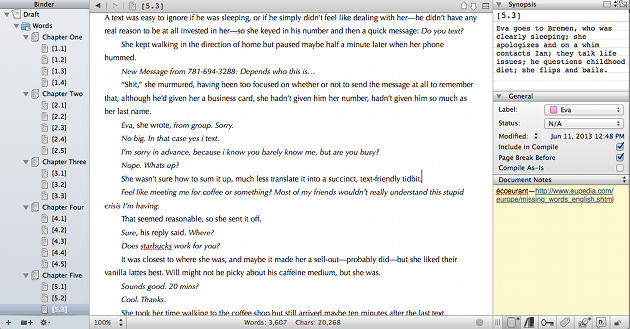
I consider myself a novelist at heart, and from a purely logistical perspective, Scrivener makes it much simpler to get a handle on, and then keep track of, that sort of long project. In a traditional word processing program, I’d end up with a couple hundred pages all in one chunk, and if I wanted to navigate between scenes, I could scroll back and forth—or search for “Chapter Three” or a unique phrase. With Scrivener, though, I could organize it differently:

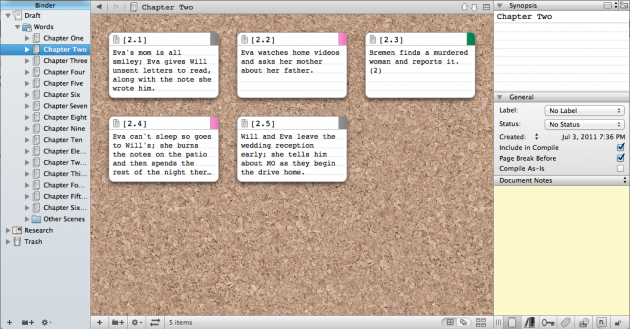
Along the left side, I have different levels of inclusiveness. If I want, I can select “Draft” and see the entire thing. Or I can select a specific chapter, or even a specific scene within a chapter. At the top right is another tool that helps with organization: the index card. This allows me to write a short summary of what occurs in that scene, so that I can look at a cork board visual of a multi-item section:

In that shot, you can also see the colored tabs in the corner, which come from the next box down from the index card editor: labels. In this particular project, I have multiple viewpoint characters, so labeling scenes with their narrator helps me see how that balances out and, if I want, view only the scenes from one character’s perspective. In the box below that are any notes I want to make that don’t need to show up on the index card.

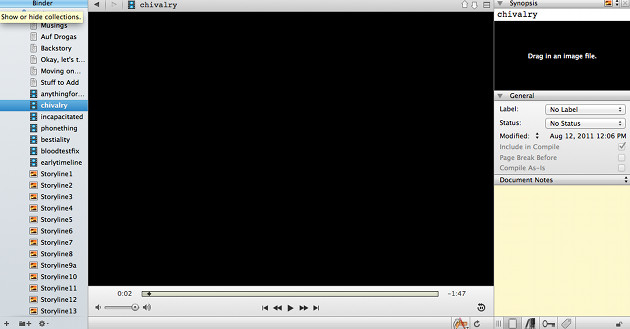
Back on the left, below the actual draft text, is the research folder, where I can take notes and import PDFs, images, video and audio clips, and more:

Essentially, what this all adds up to is one document in one application that does everything I would do in several files in several applications in several levels of folders.

(All those features, by the way, made it very useful for taking notes in class, writing multi-part papers, and organizing my graduate school application materials as well.)

In case you’re wondering, yes, I can import Word documents. And what’s more, I can save my own writing as a Word document—or PDF, rich text, Open Office, and several eBook formats. With Scrivener, I can take a novel and format it for Kindle, including everything from a cover image and author information to a hyperlinked table of contents. This feature does require a bit of trial and error at first to get all the different formatting options set, but it’s worth it.

That’s my rating of Scrivener as a whole. Absolutely 100% worth it. At the moment, it’s $35–45, and it’s worth it. There is a learning curve, and although I’m not someone who typically does tutorials, I recommend the Scrivener one, which is worth it. If you’re part way through a project, or even working on revising a completed draft, transitioning to a new format takes time, but it is—you know where this is going—worth it.

On that repeated note, I’m off to my current novel in progress Scrivener.

A Place for Everything (and everything in its place)

In this final week before I embark on a new novel, I’m working to lay out a trajectory—get a sense of where I’m going and how I’m going to get there. Problem is, in ways, I don’t have much.

This project is different from others in that it’s grounded in place. Setting has never been a strength of mine, although I can’t claim I’ve given it due attention. Typically my settings amount to “nondescript city,” and outside passing references (to the weather, or traffic patterns at rush hour, or the bar where all the underage kids go to drink) it doesn’t come up. This, though … this is (literally) another story.

Several months ago, I read China Miéville’s The City & The City. We follow Inspector Tyador Borlú, a resident of the fictional European city of Besźel, which is mixed in with the city of Ul Qoma. Both occupy the same geographic space, more or less, with areas that are wholly one or the other and areas that are “crosshatched” blends of both, but they are politically separate, complete with a sort of border security and a customs office one must pass through to legally cross into the other city. Without this setting, the story (a murdered girl found dumped in a lot) becomes generic; with it, the story is deepened and complicated. Enriched. The City & The City could not take place in Anytown, Midwestlandia, or be transplanted to London; its development is predicated upon the complexities of Besźel and Ul Qoma, to the point where the cities become more than a simple backdrop.

So what of my upcoming project? Without going into details—something I don’t like to do before getting a first draft down—I can say that the story, like The City & The City, relies on location in an active sense. At least, it will, once I come up with it.

A Novel Idea (because nobody has used that pun before)

I call myself (i.e., have come to accept being called by others) the tiniest writer, but my writing tends not to be tiny. (I have talked about this some in the past.) Most of the projects I take on with excitement are novels, as opposed to short stories, and a few years ago when I experimented with screenwriting, I did much more with full-length screenplays than shorts.

I’m not a novel-writing expert. I’ve never sold or published a book, and although I’ve finished several drafts—both first drafts and revisions—I’ve never felt like a project was really and truly complete (although from what I hear, it’s possible I never will). Still, I have finished several drafts, so that bumps me a step ahead of other aspiring novelists who have shoe boxes (or, I suppose, computer files) full of first chapters and nothing else.

I’ve been talking to a writer friend recently about doing our own -NoWriMo—the write-a-novel-in-a-month deal. She’s made a couple novel attempts in the past, but she always loses direction/momentum/something part way. She asked about my preparation process, which got me thinking about it in specific terms, trying to articulate it.

One difficulty I have in explaining this is that my drafting process is often sprawling, in a sense. I can finish a draft in relatively short order, but I often find a deep structural or conceptual flaw with it during the revision process and end up setting it aside for anywhere from months to years. My most recent project is a reworking of one I first drafted in 2008, and perhaps four years is the magic period, because in 2010 I re-envisioned a novel from 2006. This is how a lot of my writing goes—I go through multiple iterations before settling into a final form—and as a result, it’s hard for me to point to one outline or preparation process, because I draw from multiple processes.

I was able to point to a few techniques I’ve used, sometimes in combination, that have been useful in helping me develop direction so that I can progress through the first draft without losing momentum. I find that this—momentum—is the most important factor for me in determining whether a novel gets written or not.

I need to start coming up with a concept for our small scale -NoWriMo, tentatively slated for February. As such, I think my next several entries will be dedicated to presenting each of these approaches and testing some of them out.

« Older posts Newer posts »

© 2026 Alice Thomsen

Theme by Anders NorenUp ↑